
Recently, I discussed how the political dynamics of the American Sun Belt have shifted in recent years due to political realignment, changes in migration patterns, and growing metropolitan areas in the region. My adopted home state of North Carolina serves as a good representation of such change.
Politically, North Carolina has undergone the same realignment that the rest of the country has undergone. The state’s urban and suburban counties have given Democrats increasingly large margins, while rural areas have given Republicans comfortable margins of victory.
Presidential elections here have become increasingly competitive in recent decades, even as voters in the state have a habit of splitting their tickets. In an era of increased polarization, ticket-splitting has become rare nationally. Yet, North Carolinians have continued the practice.
Seven of the last eleven presidential elections were decided by 5% or less in North Carolina. Republicans won all but two of these elections. At the gubernatorial level, over the same period, Democrats won all but three elections. The Tar Heel state is one of a few that hold presidential and gubernatorial elections on the same day – meaning that most of the time in recent state history, voters supported the Republican nominee for President while backing the Democratic nominee for governor.
Today, around half of North Carolina’s residents were born outside of the state’s borders. As someone who fits into this category, I can personally attest to the fact that people relocate to the Tar Heel state for economic opportunity, the state’s renowned hospitality, mild climate, and relative affordability.
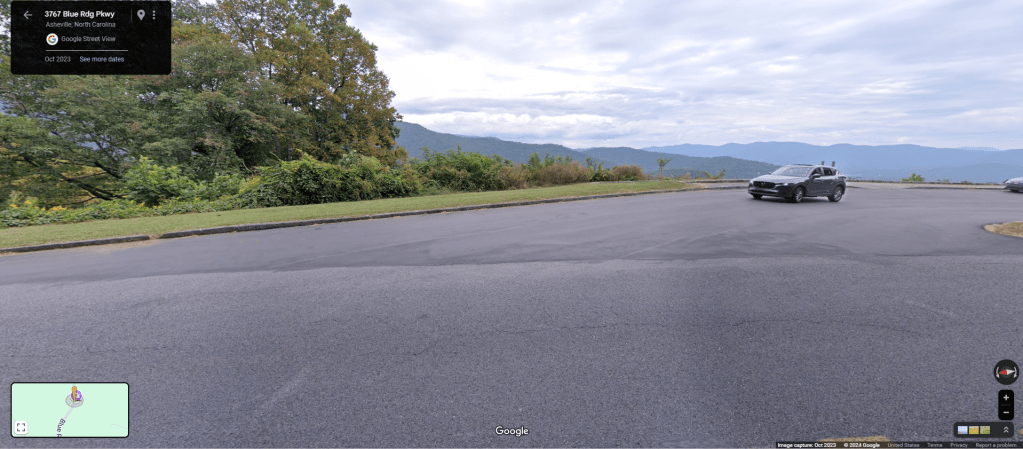
Blue Ridge Parkway, Asheville, NC (Street View). Google Maps. 2024-10-27 https://www.google.com/maps

Downtown Wilmington, NC (Street View). Google Maps. 2024-10-27 https://www.google.com/maps
Two counties that speak to changes North Carolina is experiencing are metropolitan Wake County and rural Sampson County.
Wake County, the most populated county in North Carolina, is one of the fastest growing in the nation. Home to the city of Raleigh, the state capitol, and surrounding suburbs, nearly 1.2 million people live in Wake County – with just under 500,000 living in Raleigh alone. Municipalities in the county that were considered by locals to be exurban and rural not long ago are now experiencing suburbanization.

A view of downtown Raleigh’s skyline from U.S. 401 Raleigh, NC (Street View). Google Maps. 2024-10-27 https://www.google.com/maps

A residential area of Cary, NC (Street View). Google Maps. 2024-10-27 https://www.google.com/maps

U.S. 98, Wake Forest, NC (Street View). Google Maps. 2024-10-27 https://www.google.com/maps
While the area’s economy is diversified, sectors with an outsized presence include government, public services, education & health services, and professional & business services. Wake County’s economic development agency touts clean energy, technology, life sciences, and advanced manufacturing as crucial to the local economy.
U.S. News & World Report recently named Raleigh as the 6th best U.S. city to live in:
Raleigh, along with neighboring Durham and Chapel Hill, is known for research/technology roots and collegiate rivalries. This tri-city region known as the Triangle lures new residents every day with strong job growth and high quality of life.
Many people who call Raleigh home are young, friendly, diverse and educated. They enjoy dining out in local restaurants – many of which have earned national accolades – and gathering over craft beers in one of the region’s many microbreweries. A strong sense of community is evident, as strangers are quick to provide a friendly conversation when standing in line at the supermarket.
Raleigh also encompasses beautiful green spaces, family-friendly museums and a growing art and music scene defined by monthly gallery walks, summer concerts and music festivals like Hopscotch.
Over the past half-century, Wake County has become a Democratic stronghold. Between 1976 and 2004, the county voted for the Republican presidential nominee in every election except 1992. What is noteworthy, however, is that the margin separating the major party candidates was five percent or less in five of those eight elections. Barack Obama became the first Democrat since 1964 to win Wake County by a double-digit margin, and President Joe Biden garnered 62% of the vote countywide in 2020. At the gubernatorial level, Wake County has been a bellwether in recent decades; since 1976, it’s voted with the gubernatorial winner every time – with Democrats winning the county all but three times.
About sixty miles southeast of Raleigh is Sampson County, a primarily rural county with a population of 60,000 residents. Large industry sectors in the county include manufacturing, agriculture, and retail. Sampson County’s major agricultural products include wheat, corn, soybeans, asparagus, squash, and sweet potatoes.

Main Street, Clinton, NC (Street View). Google Maps. 2024-10-27 https://www.google.com/maps
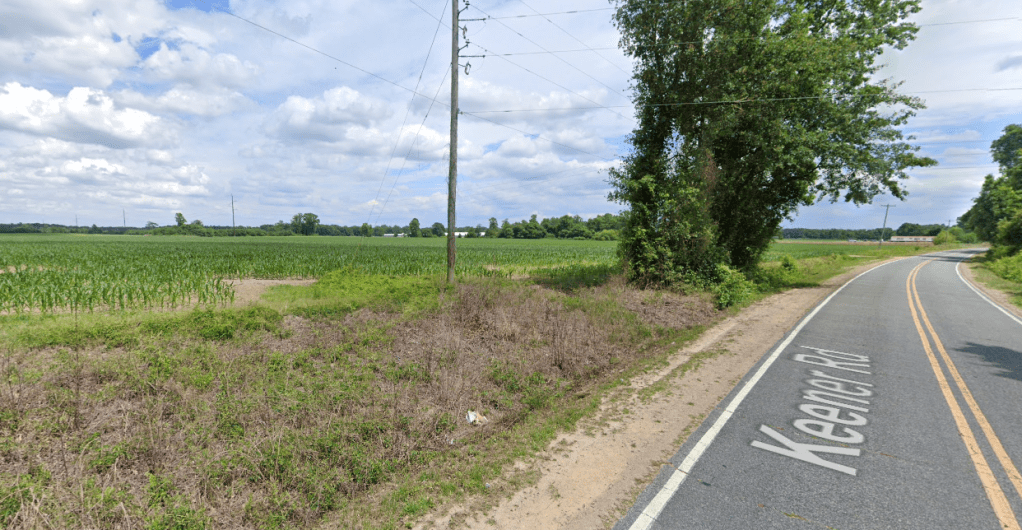
Keener Road, Faison, NC (Street View). Google Maps. 2024-10-27 https://www.google.com/maps
Politically, Sampson County has become increasingly Republican in recent years. Since 1976, the Democratic nominee for president has only carried Sampson three times (1976, 1980, and 1992). In 1996, Republican Bob Dole carried the county by around 0.5%; four years later, Republican George W. Bush won the county by a 54%-46% margin. In the last presidential race, Republican Donald Trump won over 60% of the vote there.
At the gubernatorial level, the area has seen a dramatic shift from blue to red. In his 1976 and 1980 gubernatorial campaigns, Democratic Governor Jim Hunt carried Sampson County with over 61% of the vote. Republican Governor James Martin narrowly flipped the county during his 1984 and 1988 campaigns, but it went for Governor Hunt again during his 1992 and 1996 campaigns. Hunt’s two Democratic successors, Mike Easley and Bev Perdue, carried the Sampson. Then, in 2012, Republican Pat McCrory flipped the county – and it has supported the Republican gubernatorial nominee by double-digits since.
What is the takeaway from all of this? I’d say there are two. First, Democrats have reason to be optimistic about their chances of success in North Carolina moving forward. As I mentioned in a post last month:
At the turn of the century, the core counties of the Raleigh/Durham and Charlotte areas – Wake, Durham, Orange, and Mecklenburg – cast around 23% of the total votes cast statewide. By 2020, that number grew to almost 26.5%. In all four of these counties, the trend has been favorable to Democrats. Compared to 2000, in 2020 Democrats saw a 35% swing in their direction in Wake, 37% in Mecklenburg, 25% in Orange, and 34% in Durham by my math. Other counties have seen impressive growth and/or a swing towards the Democratic Party. The Greensboro and Winston-Salem areas voted for Republican George W. Bush in 2000, but then went decisively for Democrat Joe Biden in 2020. Growth in the Buncombe County city of Asheville, arguably the most progressive city in North Carolina, has permanently flipped that county.
While these trends have favored Democrats and are likely to continue to do so, Republicans still have some hope because much of rural North Carolina remains favorable terrain for them. Only Texas has a larger number of residents living in rural areas.
But wait, there’s more! There are signs that rural and exurban counties located within or just outside of North Carolina’s metropolitan areas could boost Democrats’ odds in the future. Some of the fastest-growing counties fit into this category, and Democrats have managed to close the gap in some of these places – albeit slowly.
The second takeaway is that political polarization has been slower statewide in North Carolina compared to other states. Of the ten states with gubernatorial and presidential elections being held on the same day, North Carolina was just one of three to split their ticket. Moreover, we are the only one of those three ticket-splitting states to do so for three consecutive elections in a row.
 Observations and Perspectives