By Jordan Chester
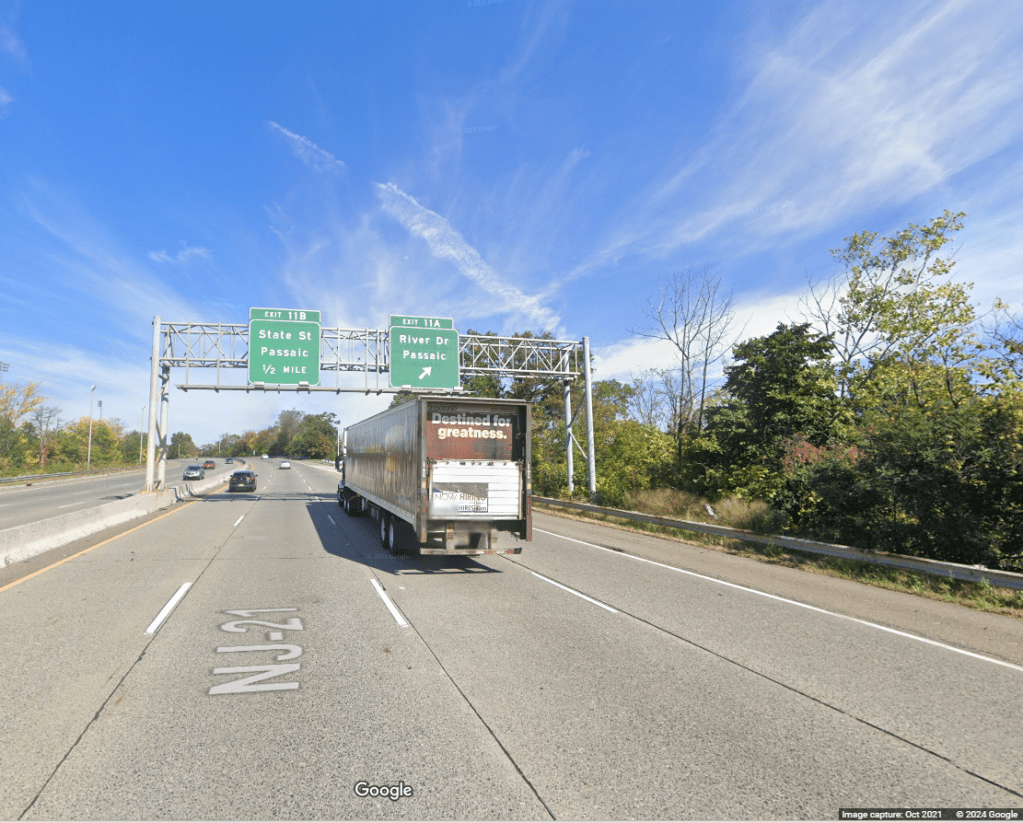
Route 21, Passaic, NJ (Street View). Google Maps. 2024-10-02 https://www.google.com/maps
There are cities and towns across the United States that have played an important role in human achievement and forming modern America. One such city is Passaic, New Jersey – a community of around 70,000 people just outside New York City.
On a personal note, Passaic has played a role in my personal family history. My late grandfather was born there on this day in 1929. He grew up in the community, joined the family business there, and continued to be proud of where he came from throughout his life. His parents, like other Jewish refugees and Europeans during the first half of the last century, settled in the area.
Passaic has long been a destination for those seeking opportunity. Black Americans fleeing the Jim Crow South and immigrants from all over the world made it their home. Census data shows that more than seven in ten residents of the city speak a second language; with Spanish, Gujarati, and Polish leading the way.
While those not familiar with the New York City metropolitan area might have thought nothing of this, Passaic has been mentioned on screen – including in The Sopranos, Get Smart, M*A*S*H, and several movies. Actress Loretta Switt, known for her role as Nurse Margaret Houlihan in M*A*S*H, is a native of the community. Television references to Passaic are particularly appropriate given its historical significance to the television industry. The city has been nicknamed the birthplace of television, as their historical society points out:
“The DeForest Radio Corporation, which was located in Passaic, New Jersey, played an important role in the early development of television broadcasting. In 1928, the company’s engineers successfully transmitted the first television signal from a studio in Passaic to a receiver located in nearby New York City. This experiment proved that television signals could be transmitted over a distance and received by a home audience.
Music has also played an important role in forming Passaic’s identity. The Capitol Theater on Monroe Street opened in the early 1920s as a vaudeville venue and became a well-known concert hall by the second half of the twentieth century. Legendary musicians including The Rolling Stones, Bruce Springsteen, The Who, The Clash, and George Harrison all performed at the venue. One of the more popular bands of the late 1950s and early 1960s, The Shirelles, hail from Passaic. Officials even renamed a street for the doo-wop band in 2008.
Before television and The Shirelles, Passaic’s claim to fame was a mid-1920s labor strike that lasted over a year. While neighboring Paterson had won an international reputation for its textile industry during the Industrial Revolution, Passaic produced its fair share of wool and silk products. The Passaic Textile Strike started when 15,000 workers at area factories walked out on the job in protest of low wages and a proposed pay cut. As striking workers marched to a nearby mill in the neighboring city of Clifton, violence broke out between workers and law enforcement. Finally, labor agreed to end the strike in exchange for being recognized as a legitimate union and having the chance to settle disputes through collective bargaining.
Like other cities in the Northeast and Midwest that experienced extraordinary growth in the late nineteenth and early twentieth centuries, the City of Passaic struggled with industry and residents moving elsewhere in the post-WW2 era.
As the New York Times reported on August 1, 1973:
Mayor Gerald Goldman of Passaic said today that the city needed $20‐million in Federal funds to revitalize the economy of a city that was facing social and economic problems, including an outflow of industry.
His statement came a day after the American Biscuit Company announced that it would close its plant in Passaic by the end of the year, putting 450 people out of work. This will be the third plant to close this year. Uniroyal and Raybestos‐Manhattan Company, which employed a total of 2,600 workers, have already closed this year.
Passaic, an industrial city with a population of 55,000, has an unemployment rate of 13 percent.
Mayor Goldman, speaking at a seminar at Columbia University, said that Passaic had been designated for Federal assistance by the Economic Development Administration but that the funds had not been released by President Nixon. Congress had already approved $650‐million for E.D.A. loans, he said.
Passaic, a once affluent town, has been beset by problems since the closure in the Depression years of the textile mills that gave it most of its income. Its problems, similar to those of other urban centers, are the outflow of the middle class to the suburbs; an acute housing shortage in the middle to‐upper class range; high unemployment, and a rising crime rate.
I’m proud to say that my Grandfather never gave up on the city in the post-WW2 era, nor did his business. On the contrary, he was elected as Vice President of the Passaic Area Chamber of Commerce in the late 1970s.

On Labor Day 1985, the community experienced another setback to its industrial base when a group of teens started a massive fire that devastated industry in the city, left several families homeless, and caused the death of a firefighter. As Time Magazine reported at the time:
The alarm shattered a droning Labor Day in Passaic, N.J., a gritty industrial city of 58,000 that lies practically in the shadow of Manhattan’s towers. When fire fighters reached the scene, they encountered what one called “a ball of fire” about 50 ft. high roaring down an alley of the factory complex alongside the city’s namesake river. The blaze churned into an inferno that leapt explosively from building to building, incinerating one instantaneously and then–boom!–vaulting on to the next. In the end, some 1,000 fire fighters were powerless to stop it. Fueled by a variety of industrial-use chemicals stored in the structures, the fire consumed wooden flooring as though it were paper and blasted through brick walls, sweeping to residences in an adjacent neighborhood. By nightfall, said Police Lieut. Richard Wolak, the stricken area looked like “four blocks of flames.”
At week’s end the fire still smoldered upon what Passaic Mayor Joseph Lipari mournfully spoke of as “40 acres of vacant land.” Gone were 23 homes, along with 17 buildings that had housed about 60 manufacturers (of plastics, handkerchiefs, chemicals, printed materials) and provided about 2,700 jobs. Damages: approximately $400 million. At least 88 families were left homeless. In one destroyed warehouse were the elaborate costumes for 75 productions of the New York City Opera. Lost also was some of the momentum that Passaic had made in a heroic effort to come back from the bankruptcy it experienced two years ago.
While investigators were trying to determine what industrial chemicals had fed the blaze, Mayor Lipari announced that the cause of the catastrophe had been traced to two twelve-year-old neighborhood boys, who had slipped through a fence and ignited a barrel apparently filled with volatile naphthalene. Said the mayor: “They stated they were playing with matches.”
While there are fewer manufacturing facilities in Passaic than there once were, independent businesses continue to operate along Main Avenue, and shoppers have a variety of dining choices in the city.
The people of Passaic have proven to be resilient, hardworking, and community-minded for generations. Today, efforts are underway to modernize the city’s business district. Improvements are being made to sidewalks, streets, and access to transit. They’ve also acquired funds to build a new high school (the same one my Grandfather graduated from in 1947) and some of its most iconic buildings are in the process of being revitalized. I know wherever he is, my Grandfather would be pleased to know this.
 Observations and Perspectives