By Jordan Chester
As I discussed in a prior blog post, the industrial states of Pennsylvania, Michigan, and Wisconsin have served as battleground states for decades. Until recently, Ohio was in that category as well. Another more recent phenomenon has been the increasing competitiveness of Sun Belt states.
As I mentioned in my post about Pennsylvania, Michigan, Wisconsin, and Ohio:
First, we’ve become a more polarized nation. For decades, it has generally been the case that rural communities backed Republicans, urban communities supported Democrats, and the suburbs went either way―perhaps slightly more Republican pre-1992 and more Democratic since. Today, Republicans are getting bigger margins out of rural counties, Democrats have maximized their urban support, and the suburbs have moved closer to the Democrats while remaining relatively competitive.
Specific to the Sun Belt, conventional wisdom suggests that Democrats have made gains in growing states with sizable metropolitan areas, while Republicans have done well where larger percentages of the population live in exurban and rural communities.
Before diving into what the data says, it is worth noting that there is some debate as to which states constitute the Sun Belt. For this post, I want to focus on five former and current swing states in the region – my adopted home state of North Carolina, Georgia, Arizona, Nevada, and Florida.
Based on data from the U.S. Census, election results compiled by Wikipedia contributors, and the help of spreadsheets, I made some calculations about how the growth of metropolitan areas has (or hasn’t) changed the political nature of these states in presidential elections.
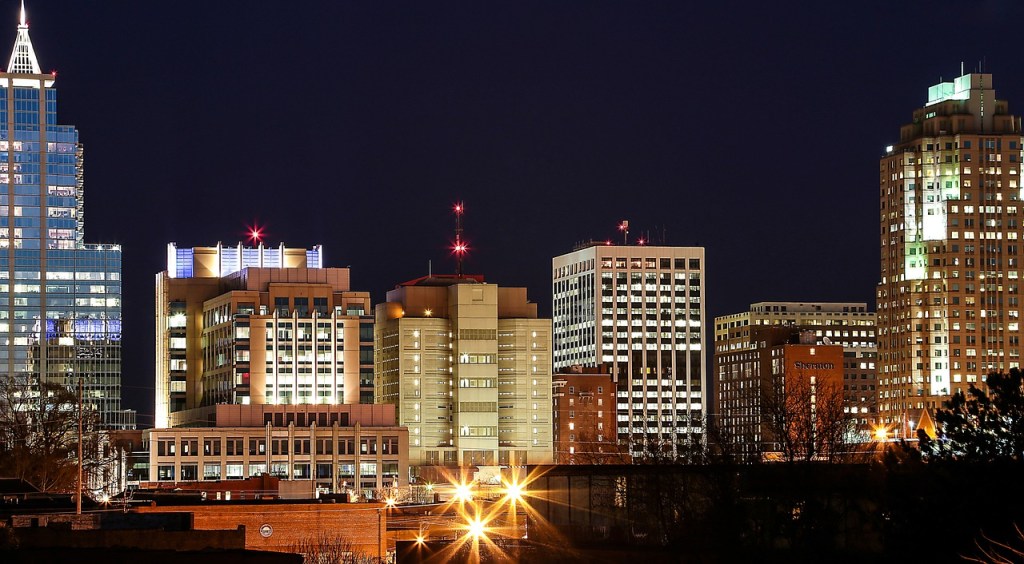
Historically, tobacco, furniture manufacturing, and textiles dominated much of North Carolina’s economy. Sensing economic change in the air, leaders the Raleigh/Durham area of the state established the Research Triangle Park in the late 1950s. They envisioned an area where scientific advancement and innovation would thrive. Today, this 7,000-acre commercial park is home to hundreds of companies spanning multiple industries, mostly within the healthcare and energy sectors.
Research Triangle Park borders two census-designated metropolitan statistical areas, which locals often consider one – the Raleigh-Cary and Durham-Chapel Hill statistical metropolitan areas. Together, these metros have an estimated population of over 2.1 million. Sometimes referred to as the Triangle, the area is also known for having renowned institutions of higher education, including North Carolina State University, Duke University, the University of North Carolina at Chapel Hill, North Carolina Central University, Meredith College, William Peace University, and Shaw University. The Triangle is home to countless independent businesses, and some of the area’s largest employers include government entities, IBM, Fidelity Investments, Lenovo, and Cisco.
North Carolina’s largest metropolitan area is the Charlotte-Concord-Gastonia metro, which has an estimated population of more than 2.8 million. The City of Charlotte has emerged as one of the largest financial services centers in the nation; Bank of America, Brighthouse Financial, AM Wins Group, and LendingTree all have their corporate headquarters there. Additionally, racing fans know Charlotte as being home to NASCAR.
A Federal Reserve of Richmond report from 2017 found that the Raleigh/Durham and Charlotte areas have increasingly diverse economies. Needless to say, economic opportunity, coupled with mild weather and top rankings on U.S. News & World Report’s Best Places to Live list has led to impressive population growth in recent years. People of all ages are relocating to the Tar Heel state, with around 30% of new residents migrating from Florida and the northeastern states of Pennsylvania, Maryland, Massachusetts, Connecticut, New York, and my native New Jersey. One study, conducted in 2018, found that almost half of North Carolina’s residents were born outside the state’s borders.
At the turn of the century, the core counties of the Raleigh/Durham and Charlotte areas – Wake, Durham, Orange, and Mecklenberg – cast around 23% of the total votes cast statewide. By 2020, that number grew to almost 26.5%. In all four of these counties, the trend has been favorable to Democrats. Compared to 2000, in 2020 Democrats saw a 35% swing in their direction in Wake, 37% in Mecklenberg, 25% in Orange, and 34% in Durham by my math. Other counties have seen impressive growth and/or a swing towards the Democratic Party. The Greensboro and Winston-Salem areas voted for Republican George W. Bush in 2000, but then went decisively for Democrat Joe Biden in 2020. Growth in the Buncombe County city of Asheville, arguably the most progressive city in North Carolina, has permanently flipped that county.
While these trends have favored Democrats and are likely to continue to do so, Republicans still have some hope because much of rural North Carolina remains favorable terrain for them. Only Texas has a larger number of residents living in rural areas. For example, Cherokee County in the Appalachian Mountains voted 23% more Republican in the 2020 presidential race compared to 2000.
But wait, there’s more! There are signs that rural and exurban counties located within or just outside of North Carolina’s metropolitan areas could boost Democrats’ odds in the future. Some of the fastest-growing counties fit into this category, and Democrats have managed to close the gap in some of these places – albeit slowly.
In Georgia, the Atlanta area is by far the largest metropolitan statistical area in the state – and it joined Raleigh and Charlotte on the list of top ten for population growth in the 2010s. An international city, Atlanta and surrounding areas are particularly popular for those relocating from the New York City area, Chicago, Miami, and internationally. The Metro Atlanta Chamber has identified manufacturing, technology, healthcare, and clean technology as key industries in the region. Major employers in this region include Emory University, Delta Airlines, and Home Depot.
The core counties of the Atlanta area – Fulton, DeKalb, Cobb, Gwinnett, and Clayton – accounted for around 37% of the votes cast statewide in 2020, up from 36% in 2000. All of these counties moved dramatically toward the Democrats over the course of this century. Fulton County voted 28% more Democratic in 2020 than in 2000, while DeKalb did so by 24%, Cobb by 38%, Gwinett by 50%, and Clayton by 38%. Cobb and Gwinett Counties actually voted Republican for president as recently as 2012.
More than six in ten Arizonans live in the Phoenix metropolitan area, which was one of the fastest-growing areas during the most recent decade. Unsurprisingly given its location, California residents are far and away the leaders in relocating to Arizona. Financial services, education, trade, and hospitality are key industries in Phoenix and the area. Major employers include Arizona State University, the state government, and Banner Health.
Voters in the two core counties of the Phoenix metro, Maricopa and Pinal, cast 66.57% of the total votes cast statewide in 2020 – up from 61.47% at the turn of the century. Compared to 2000, these counties moved in opposite directions; Maricopa went for George W. Bush in 2000, and Joe Biden became the first Democrat since Harry Truman to carry the county in 2020. Bush eeked out a win in Pinal County in 2000, and Donald Trump won it in 2020 by an even larger margin.
Known for it’s hospitality and entertainment industries, the Las Vegas-Henderson metro is home to a majority of Nevada residents. Like other Sun Belt states, between 2000 and 2020, the percentage of votes cast statewide from the two core counties in this metro – Clark and Nye (though only part of Nye County is considered part of this metro) – increased from 64.76% of the statewide vote to 71.01%. Clark voted Democratic in both of these elections while Nye voted Republican. What is notable, however, is that Clark swung just 4% to the left while Nye voted more Republican. In other words, Republicans should be optimistic that Nevada will remain within their reach, at least based on recent historic election results.
Florida has emerged as a welcoming place for more conservative voters looking for warmer weather and no state income tax. Key industries throughout the state include aerospace, defense, financial services, manufacturing, logistics, and more. Between Disney, beaches, and resorts, the hospitality industry is also thriving in the state.
There are four metropolitan statistical areas of Florida with more than a million residents – Miami-Fort Lauderdale-West Palm Beach, Tampa-St. Petersburg-Clearwater, Orlando-Kissimee-Sanford, and Jacksonville. Core counties in these areas include Palm Beach, Broward, Miami-Dade, Orange, Seminole, Hillsborough, Pinellas, and Duval.
In 2000, eight core counties of Florida’s metropolitan areas cast 51.58% of the statewide ballots. Unlike North Carolina, Georgia, Arizona, and Nevada where key metropolitan counties increased their voting power, these counties only cast 50.24% of total Florida votes in 2020 – a decline. All of these counties increased in population according to the most recent census.
The swing between 2000 and 2020 was 14% towards the Republicans in Palm Beach, 7% towards the GOP in Broward, virtually no change in Miami-Dade, 21% towards the Democrats in Orange, 4% in Democrats’ direction in Duval, over 3.5% more Republican in Pinellas, 10% more Democratic in Hillsborough, and 15% in the Democrats’ direction in Seminole.
Put another way, the Miami-Dade region has shifted towards the GOP, offsetting any gains Democrats made elsewhere. Add stronger GOP margins out of other parts of the state, including rural areas, and it makes sense that Republicans have made gains in the Sunshine State.
While political realignment and changes in migration can explain a great deal about the changing political dynamics of Sun Belt states, these factors don’t tell the entire story. In a future post, I’ll expand on this.
 Observations and Perspectives